You've interviewed three candidates for an open position. All three have relevant experience, answered your questions well, and seem capable of doing the job. Now comes the difficult part: deciding which candidate is the best fit.
One interviewer prefers the candidate with the most experience. Another likes the person who seemed most confident. A third remembers a particularly strong answer but can’t recall how the other candidates responded.
Without a consistent evaluation process, hiring decisions can become heavily influenced by personal impressions rather than the qualifications that matter most. An interview scorecard can help solve this problem.
What is an interview scorecard?
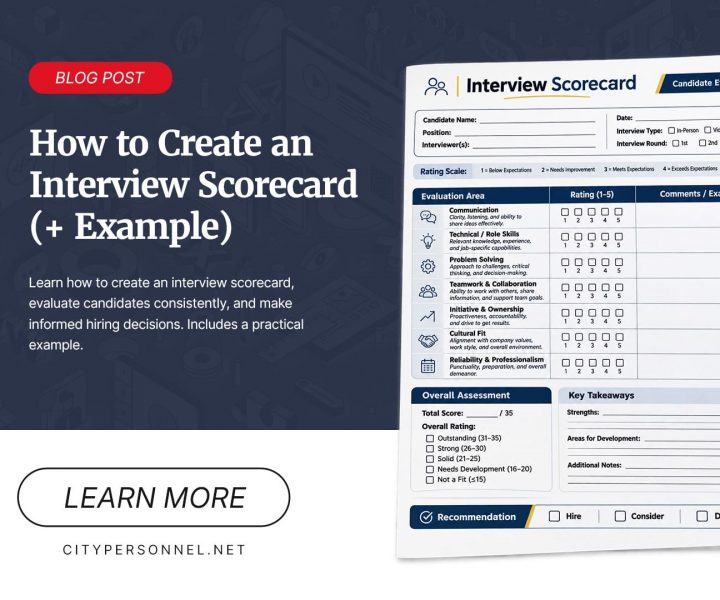
An interview scorecard is a structured evaluation tool that hiring managers use to assess candidates against predetermined criteria. Rather than relying entirely on general impressions, interviewers assign ratings to specific skills, qualifications, and competencies required for the position.
For an administrative assistant position, an employer might evaluate:
- Relevant administrative experience
- Organization and time management
- Problem-solving skills
- Written and verbal communication
- Microsoft Office proficiency
- Attention to detail
A scorecard doesn't replace an interviewer's judgment. It gives that judgment a clearer, more consistent foundation.
Why employers use interview scorecards

A more consistent interview process
When different interviewers ask entirely different questions, comparing candidates becomes difficult. One candidate is asked about handling deadlines; another spends most of the interview discussing previous employers. Structured interviews ask every candidate the same core, job-related questions — scorecards add a common framework for evaluating the answers.
Less room for personal bias
Someone who communicates confidently may leave a favorable impression even when another candidate has stronger qualifications. Scorecards don’t eliminate bias, but criteria set before meeting anyone, and scored consistently, reduce the opportunities for subjective judgments to decide the outcome.
Decisions that are easier to explain
Instead of debating whether someone “seemed like a good fit,” the team discusses specific evidence: a detailed account of managing competing deadlines, or a gap in experience with a required software program.
Better records of every evaluation
Interviews often run over several days or weeks. A scorecard keeps a consistent record of each candidate’s responses — and shows the team which parts of its process need work.
How to create a scorecard in five steps
1
Identify the most important qualifications
Review the position’s responsibilities. Which skills are absolutely necessary to do the job? For an accounting assistant, attention to detail and financial records; for a customer service representative, communication and handling difficult situations.
Skip requirements that only appear because they were in previous job descriptions. Most practical scorecards use four to six categories; complex roles may need more.
2
Create a consistent rating scale
A five-point scale is straightforward and gives interviewers enough room to distinguish levels of qualification. Make sure everyone understands each rating before using it — and define what a strong answer looks like for each competency.
3
Ask the same core questions
Candidates need a comparable chance to demonstrate their qualifications. Follow-ups are fine for clarification, but core questions stay the same. To evaluate problem-solving, you might ask:
“Tell me about a time you encountered an unexpected problem at work. What happened, and how did you resolve it?”
4
Weight the critical skills
Not every qualification matters equally. For a customer service role, communication might carry 30% of the evaluation and software proficiency 10%.
Set weights before interviews begin, and never change them afterwards to favor someone who made a strong impression.
5
Document evidence, not just scores
A number doesn’t explain itself. Instead of “Great communicator,” write: “Explained how they resolved a customer complaint, including the steps taken and the final outcome.” Notes like this make the final decision easier to revisit.
Example: Administrative Assistant
This sample uses weighted criteria, each scored from one to five. The weighted score is each rating multiplied by its weight, summed. Adjust the scores to see how the overall result moves.
A numerical score shouldn’t automatically decide who receives an offer. Review the underlying evidence and verify essential qualifications — the highest total may still belong to someone missing a mandatory certification.
Common mistakes to avoid
Vague categories
“Personality” and “culture fit” mean different things to different interviewers. If collaboration matters, evaluate observable behavior: how candidates communicate with colleagues, resolve disagreements, or share responsibilities.
Scores without evidence
Every interviewer should be able to explain a rating using information from the interview or another relevant assessment.
Treating it as the whole process
A scorecard complements resume reviews, skills assessments, and reference checks. It doesn’t replace them.
Should every company use the same scorecard?
No. An effective scorecard should be tailored to the position. The evaluation criteria for a legal assistant will differ from those used to assess an accounting specialist, customer service representative, or human resources coordinator. Even two positions with the same job title may require different skills depending on the organization.
For example, an administrative assistant at a small business might manage scheduling, customer communication, and invoicing. At a larger organization, the same title might involve specialized support for a particular department. The scorecard should reflect what successful performance looks like in that specific role.
How a staffing agency can help improve candidate evaluations
Creating a consistent interview process is an important part of hiring, but it doesn’t eliminate the time required to find and screen qualified applicants. Businesses still need to review resumes, identify candidates who meet their requirements, schedule interviews, and determine who should move forward.
That’s where working with an experienced staffing agency can help.
Since 2006, City Personnel has helped employers throughout Rhode Island and Southern New England identify qualified candidates for administrative, accounting, customer service, legal, human resources, and other professional positions.
Our recruiters work with employers to understand the responsibilities, required skills, compensation, and expectations associated with each opening. Rather than simply forwarding resumes, our team focuses on presenting candidates whose qualifications align with the position.
Whether your organization needs temporary support or is looking to fill a permanent role, a clearly defined evaluation process can help both your hiring team and your recruiting partner stay focused on the qualifications that matter.
Preparing to hire?
If your organization is preparing to hire, City Personnel can help you identify qualified candidates and simplify the recruiting process.
Contact City Personnel today to discuss your hiring needs in Rhode Island, Massachusetts, or Connecticut.
Frequently asked questions about interview scorecards
An interview scorecard is a structured evaluation form used to assess job candidates against predetermined qualifications and competencies. It helps hiring managers compare candidates more consistently.
An interview scorecard typically includes job-related evaluation criteria, a standardized rating scale, space for interview notes, and an overall assessment. Some employers also assign weights to particularly important qualifications.
Interviewers evaluate the candidate's responses against predefined criteria, often using a rating scale from one to five. Scores should be supported by specific examples from the interview rather than personal impressions.
Interview scorecards can support more consistent hiring decisions when paired with structured questions, clearly defined rating standards, and job-related evaluation criteria. Their usefulness depends on how well the scorecard is designed and applied.
A structured scorecard can reduce reliance on subjective impressions by focusing on predetermined, job-related qualifications. However, it doesn't eliminate bias, and employers should regularly review their evaluation criteria and practices.