
When on an interview, it is common to think of it as a “structured conversation where one participant asks questions, and the other provides answers.”
However, whether you are meeting with a recruiter or on an interview with an employer is not only a time for the interviewer to ask you questions BUT for you to learn more about the role you are applying for. We have often had candidates email us a few hours after completing the interview to ask us several questions about the job opening. These questions can, and should, be asked during the interview.
We suggest creating a list of several insightful questions to ask during the interview because it shows that you are professional, committed, and eager to learn more about the role. Questions are a good way to learn more about the role before you accept it. An interviewer can’t go over every detail of the position in an interview, so questions should be asked to help prepare you for what you are getting into with the position you are interviewing for.
In this blog, we will be going over some of the best questions you can ask during your interview to show that you are prepared and willing to start work!
Asking Questions During an Interview
Many candidates are hesitant about asking questions during an interview because they don’t want to come across as ‘difficult’; however, asking questions in an interview shows that you are prepared, eager, and interested in the role.
We suggest taking a binder to all of your interviews. In the binder should be a pen, notebook, and folder with several copies of your resume and a premade list of questions you will ask during the interview. The list you create can be similar to the questions we go over in this blog, but if a question is answered during the beginning of the interview, don’t ask it again! An example of this is if your interviewer goes over how long he has been with the company, and later you ask, “How long have you been with the company?”
If you ask a question that has already been answered, you will likely not get the job. On the other hand, asking a question that has already been answered shows that you weren’t paying too much attention! Before finishing your next interview, consider asking the following question.
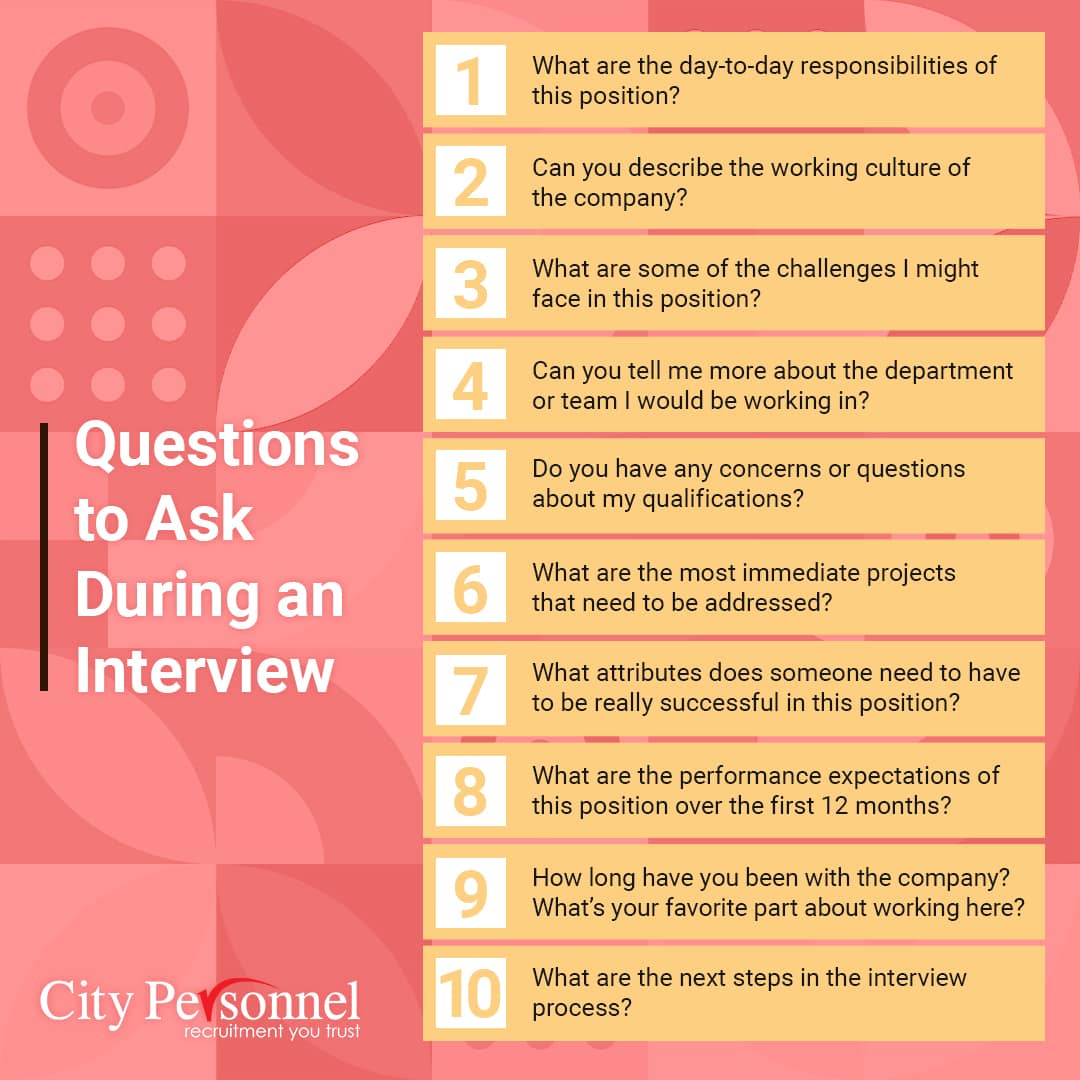
What are the day-to-day responsibilities of this position?
One of the best questions you could ask on an interview if it hasn’t been answered yet. Asking about day-to-day responsibilities will help you understand if the position would be a good fit for you. For example, if you are not the best at your communication skills and the position requires you to cold call all day, this may not be the best position for you.
Also, asking about the position’s responsibilities will help you understand what your days will be like at the position and help you prepare for it. If the day-to-day responsibilities include working on Excel for most of the day, taking a refresher class on Excel may be ideal before starting!
Can you describe the working culture of the company?
Do you want a job where you are happy to come to work every day? Asking about the working culture is a great way for you to get a feel for how well you will fit in. The four most common types of work cultures are hierarchal cultures, market-driven cultures, clan cultures, and adaptable/flexible cultures.
What are some of the challenges I might face in this position?
When asking this question, make sure to bring a real-world example of how you solved a similar problem. For example, if they answer “handling complaints from customers,” bring up an example of how you have handled complaints from customers in the past.
Asking some of the challenges you might face in the role shows an employer that you are proactive and quick to solve problems.
Can you tell me more about the department or team I would be working in?
This question is a great way to understand how the company is structured. The answer to this question will help you understand if the company is a team environment, who you will be working with, and who you will be reporting to.
Understanding the team you work with before you are hired will help you see if you are a good fit for the position. You will usually be with the team majority of the time at the position, so understanding who they are and how they work is ideal before accepting a job offer.
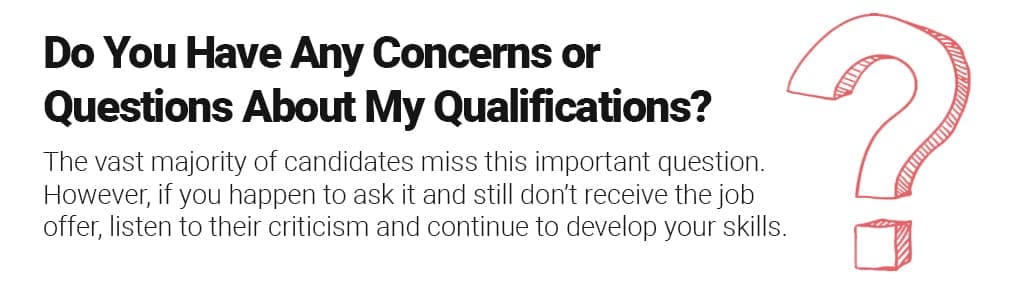
Do you have any concerns or questions about my qualifications?
Feedback is important. Asking for feedback is a great way to know what you have to improve on. This question also shows that you are open to constructive criticism. To succeed in any role you are in, you need to be open to constructive criticism.
If they do have concerns, this is the best time for you to address them quickly and how you will improve upon them. For example, if an employer is concerned about your lack of writing skills, go ahead and explain what you have done in the past and how you will continue to improve upon them.
The vast majority of candidates miss this important question. However, if you happen to ask it and still don’t receive the job offer, listen to their criticism and continue to develop your skills.
What are the most immediate projects that need to be addressed?
Asking about what projects you will be introduced to during the first few weeks of work is a great way to see what to expect in your first couple of months at the position. This question is also a great way to prepare for your first days of work.
If the company goes into detail about all the immediate projects that need to be completed, they are usually interested in hiring you. Use this question to your advantage!
What attributes does someone need to have to be really successful in this position?
When asking this question, make sure to respond with how you have those attributes listed. If they respond with “problem-solver,” bring up a time you where you had to problem-solve. Whatever the answer is, make sure to relate that back to your work experience and why you would be a great fit for the role.
If you aren’t the best at problem-solving or handling stress, check out our webinar on Tools to Manage Stress. The best way to get better at something is to learn more about it and develop your skills!
What are the performance expectations of this position over the first 12 months?
Companies usually require employees to meet certain goals each year. Asking a question about what performance expectations there are for the first 12 months shows that you are eager and willing to meet those requirements.
How long have you been with the company? What’s your favorite part about working here?
Asking questions about the interviewer will help you understand more about the work culture. For example, if your interviewer has been with the company for 5+ years, you will know that the company’s employees have long careers with the company. On the other hand, if they say less than 2 months, then be wary.
Asking your interviewer’s favorite part of working at the company will get a real answer out of them. For example, if their answer is “everyone gets along, and we have Fridays off,” then you know it is a great company to work for. However, if their answer is something small like “my favorite thing is that they have two fridges in the office,” it shows that everything else may be boring.
What are the next steps in the interview process?
Your last question should always be this one. How will you know the next steps if you don’t ask? If you forget to ask, make sure to follow up via email. If you leave without asking this question, employers may think you aren’t very interested in the job.
Now that you have a list of 10 questions to ask during an interview, are you ready to start applying?
Here at City Personnel, our candidates are the backbone of our mission. Our ultimate staffing goal is to foster rewarding relationships while finding the perfect job match for you. We are committed to placing you in a position that compliments your skillset and provides job satisfaction. Are you still hesitant about using a staffing agency? Here are the benefits of using City Personnel!